
Stokesville, C&W Company Town & End-of-Track
Ask an Author with Clarence Geier
Friday, March 13, 2026, 10:30 am
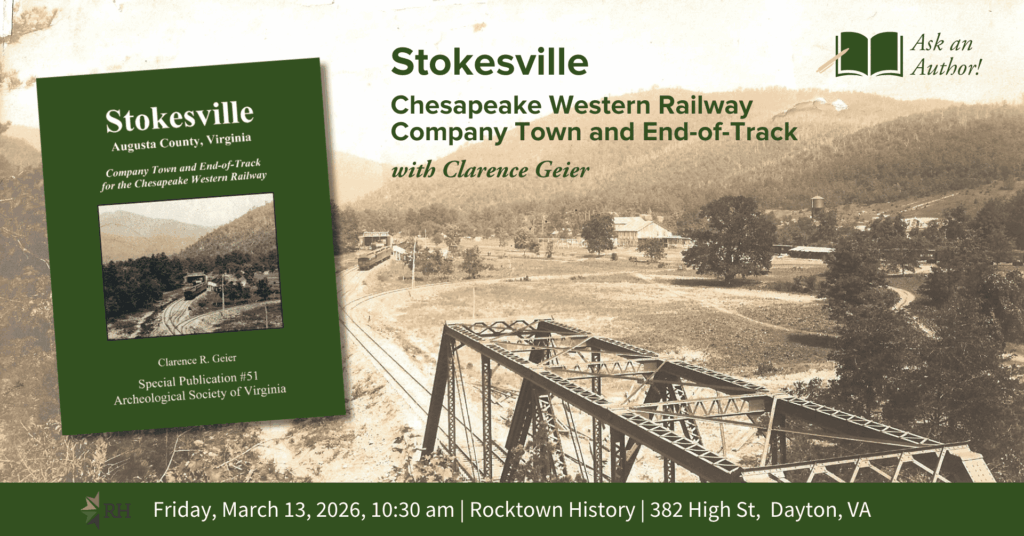
Established in 1901, the mountain town of Stokesville was founded, thrived, and lost to history in roughly 13 years. The history and productivity of the town were intertwined with the development of the local Chesapeake Western Railway. Stokesville was end-of-track for the railroad, and became a company town created to extract, process, and ship the wealth of natural resources from within the interior mountain landscape.
Stokesville provides an example of a short-lived community tied to resource extraction in western Virginia. Towns such as this, often funded by Northern capitalists, contributed to the post-Civil War economic recovery of the Shenandoah Valley.
This research is grounded in field archaeology. The manuscript also includes information on:
- post-Civil War railroading in the Valley including methods of laying track
- the economic impact of the Chesapeake Western Railway
- the importance of coal for attracting financial backing for the Railway
- the nature and importance of lumbering and the harvesting of tanbark
- the industrial and residential features that made up the Stokesville community.
A special publication of the Archeological Society of Virginia, Stokesville is a study of a type of ephemeral company town that provided economic prosperity to areas of western Virginia. The volume interprets the photographic record and architecturally documents the very small number of remaining period structures.
Clarence Geier is emeritus faculty at James Madison University. He taught Anthropology and Archaeology in the Department of Sociology and Anthropology for 38 years and directed Archaeological Research studies across much of Virginia. Along with the field work at Stokesville, he has been involved most recently with historic and military studies working with the National Park Service and other groups in the Fredericksburg vicinity and the lower Shenandoah Valley. His last field work involved a five-year study of the historic settlement of, and Civil War military actions along, Cedar Creek in southern Frederick County.