
“Chico nico, Chow Chow Chow”
Remembering West Central Academy
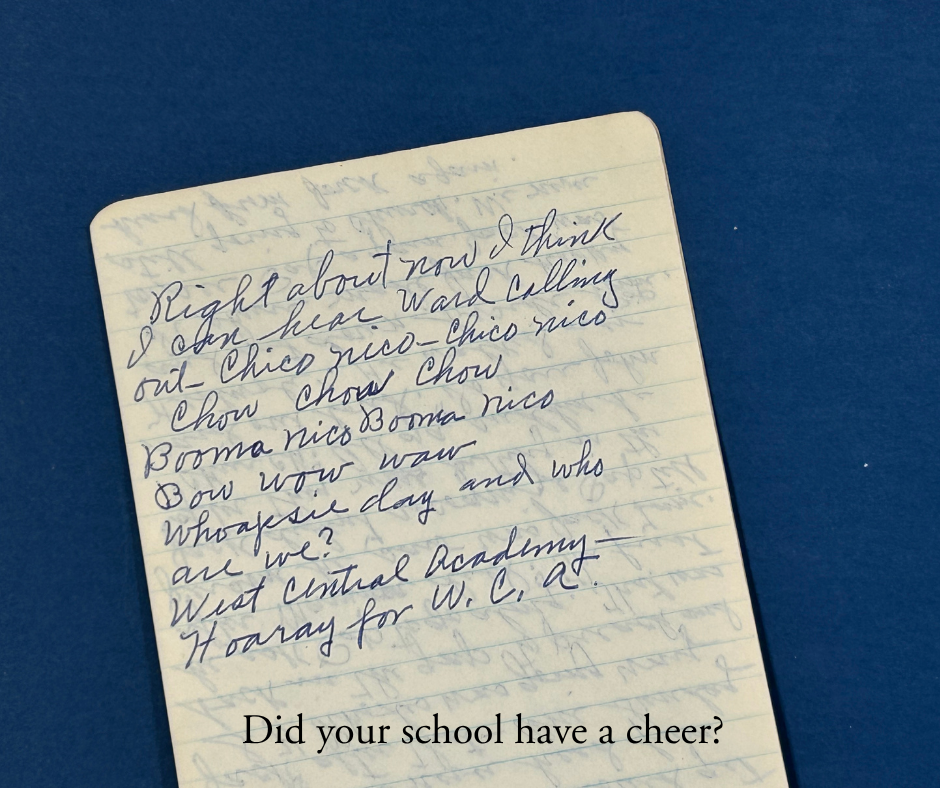
Did your school have a cheer? Katie Heatwole remembered hers.
Years after attending West Central Academy in Mt. Clinton (about six miles west of Harrisonburg), she wrote this school cheer in a memory notebook—and we’re very glad she did. The words may be a little silly to us now, but they preserve something that course catalogs and school records rarely capture: what it felt like to be a student.
West Central Academy was quite a school to cheer for.
It began modestly in 1890, when Presbyterian minister Benjamin T. Hodge proposed offering advanced classes to local students. Abram B. Driver made room above his store in Mt. Clinton, and 33 students enrolled for that first session.
That experiment grew quickly. By 1892, an eight-room academy had been built, eventually joined by a chapel, separate dormitories for young women and men, and 12 acres of vegetable gardens that helped supply the dining hall.
Principal Isaac C. Wampler named it West Central Academy for its location in the western part of Rockingham County’s Central District.
An “academy” offered students an education beyond the basics of the graded schools and could prepare them for college, teaching, business, or what the school’s own letterhead called “an active, useful life.”
And the curriculum was impressive: algebra, geometry, trigonometry, French, German, Greek, Latin, rhetoric, civil government, psychology, astronomy, geology, botany, chemistry, physics, zoology, art, music, business courses, and more.
West Central also became important in training teachers. Historian John W. Wayland wrote that by about 1897, an estimated 65 percent of Rockingham County’s teachers had at some point been students there.
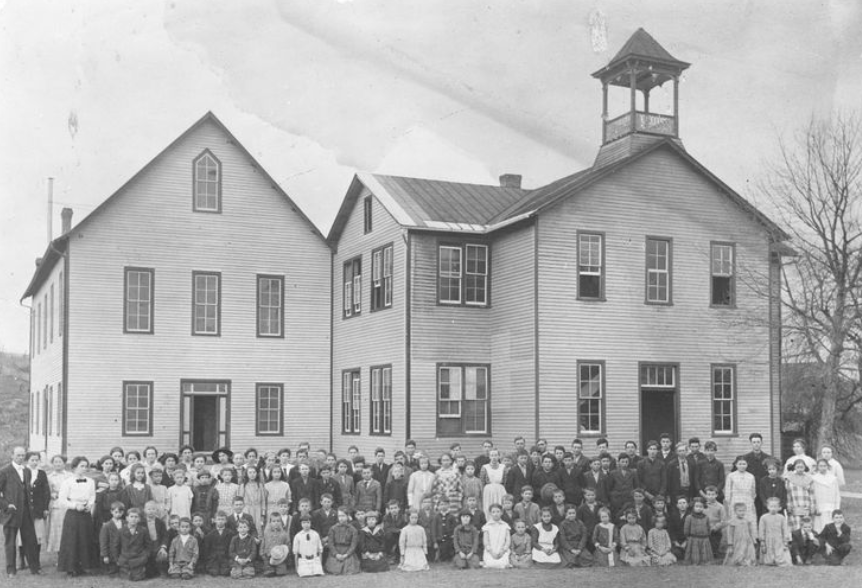
West Central was a semi-public institution—something quite different from today’s division between public and private schools. The district school board helped fund the academy building and teachers’ salaries, while patrons and other community supporters raised private money for additional buildings. Students, meanwhile, paid tuition.
For a resident student in 1897–98, a furnished room cost $2 per month and meals another $4.75 to $5.50. Tuition averaged $9.75 per month for the preparatory course, $10.25 for high school, and $10.75 for the commercial course. Fuel was extra.
And how did West Central attract students and reassure their parents? Along with promoting its faculty and affordable education, advertisements pointed out that there were “no bar rooms within six miles of the place.” Mt. Clinton was also advertised as “entirely free from malaria and kindred diseases.”
Apparently a good education, inexpensive room and board, clean air, and considerable distance from temptation made a compelling package. At its peak, the academy enrolled about 170 students; however, education was changing. As Virginia moved toward free public high schools in the early 1900s, enrollment declined. West Central’s final academy session was held in 1902–03, and the building became Mt. Clinton High School the following year. The old name, however, stuck around for years.
The academy building itself is gone today, but pieces of its story survive—in old newspapers and school records, in former dormitories converted to homes, and even in a cheer remembered and written down by a former student.
That’s one reason diaries and journals can be such wonderful historical records. Katie Heatwole didn’t just leave us names and dates. She left us a little school spirit.
So, did your school have a cheer? What school-day memory might you leave for someone to discover years from now?
Information about West Central Academy courtesy of Dale MacAllister.